
Sandy, Tony and Graham headed off to the Northumberland Coast for 4 star sea kayak assessment. The four star leader assessment checks that we have the personal skill level and leadership ability required to lead a group of paddlers, on short (6 to 8 miles, of at least 3 hours paddling), single or multi-day journeys in a moderate tidal water environment with winds not exceeding Beaufort Force 4.
Sounds fine but what is moderate tidal water?
- A stretch of coastline with available landings every 1 to 2 miles or 1 hour paddling, including areas where it is not easy to land.
- Crossings not exceeding 2 nautical miles.
- Up to 2 knots of tide (but not involving tide races or overfalls).
- Winds not exceeding Beaufort Force 4.
- Launching and landing through surf (up to 1 metre, trough to crest height).
That sounded fine too , we had done the training, practiced in the pool, paddled on sea trips (and river trips), and prepared or borrowed the kit needed for the kit list. How hard could it be? Had we done enough preparation? Would the conditions be tough enough or would the course be cancelled?
Here is a description of our trip.
Day 1 – a drive to Northumberland , some sea kayaking course revision chat in the car, check into the Alnwick Youth Hostel and a lovely dinner in a pub.
Day 2 – The weather was sporting, winds at Force 6 and 6 foot waves battering the coast. Fortunately our assessor had a plan and we spent the day in a harbour mouth hiding from the worst of the weather. Before that was the paperwork checks: ?logbooks showing our experience, registration forms and first aid certificates. ?Once launched we had to show our personal and rescue skills
- Towing an injured paddler to shore.
- Landing and launching on a rocky shore with some waves.
- Repairing a boat that was holed on the bottom (getting out of the boat onto a raft in the middle of the waves, drying the boat in the rain and then applying super sticky tape while a team mate towed the raft to hold its position)
- Repairing a boat that had lost its hatch cover and filled up with water in the back hatch (best done with some spare hatch cover repair kit and empty airbags)
- Jumping into the wavy sea and being rescued by a partner.
- Jumping into the wavy sea and self rescuing (paddle floats at the ready).
We did all of these back to back, with limited rests. By the end of the day we were quite tired. Not everything had gone to plan the injury list for the day included
- a failed roll and swim for Graham,
- a missing split paddle for Graham (lost during one of the group rescue scenarios),
- some bruised legs for Graham while getting out of the shore side of the boat on a rocky shoreline (a river paddlers bad habit.)
- wet kit for sandy (how many drybags is enough!)
- guidance for Tony to stop being his nice driving instructor self and unleash his inner dictator!
Back to the bunkhouse for a rest, 2 hours of kit adjustment and weather/ tidal planning ready for the following day and out for more dinner. Sandys best efforts to dry out his VHF radio had failed and it was now considered to be gubbed. No late night this night.
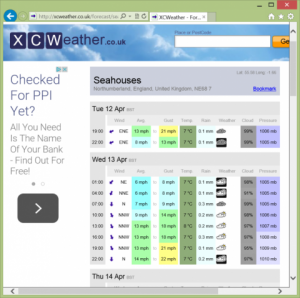
Day 3 ? Beadnell Harbour to Low Newton-by-the-Sea and back.
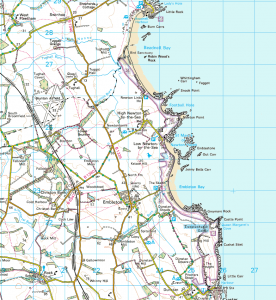
2 volunteer paddlers joined us for a journey 6km down the coast and back with the leaders taking turns being leaders. ?The wind had dropped to force 3, but still with 3 foot swell and some headlands and hidden shoals to pass safely . The day flew by with pretty constant paddling, a short break for lunch and a slog into a headwind back to the start. A review of what gear we carried in our boats to finish and then a wait for the results.
The results.
3 passes – our personal paddling was good but we had some homework in 2 main themes:
- Slicker rescues. We could all have been faster at deciding what to do and then doing it. Having waves bouncing up and down definitely makes things slower but it shows when you havent practiced enough.
- Better (and maybe even a bit less) equipment that is better organised in the boat. Having the necessary gear readily to hand and a plan of how to use it makes everything better. Quick and dirty things to have close to hand ready for fixing stuff were? a spare hatch cover and maybe a spare air bag, some super sticky tape for a hole, a snack for tired people, hot drink for cold people, some tape for paddling blisters. Also close to hand (or on body) for emergencies such as flares, radio etc.
Who is 4 star training (and assessment) for?
If you paddle on the sea then the things that the 4 star award has could make you a better and safer paddler for yourself and the others in your group. Having the right kit, enough knowledge about the weather and the sea and knowing how to use it go a long way to avoiding accidents, incidents or tragedies. Although courses are available everything you need to learn is available in the club and through reading and practicing! Getting wet in waves when practicing makes it easier if it is ever for real.
More info about the skills for a four star paddler are at : http://www.canoe-england.org.uk/media/pdf/BCU%204%20Star%20Sea%20Leader%20Training%20Notes%20V3-1%20Feb14.pdf
You must be logged in to post a comment.