
Sea Kayaking / Touring Trip / Expedition Grades

In order to give you some idea of the type of trip and conditions you might experience, trips are graded from A (lowest) to C (highest – most challenging). They can vary from a day paddle on a sheltered inland loch to the exposed headlands, cliffs, crossings and tide races among some of Scotland’s rugged coastlines and islands. If you are a newcomer you should start off on a Grade A trip so that you can judge your capabilities against other paddlers and minimise the risk to yourself. The grading system offers a way to progress your own skills incrementally. Not all paddles fit neatly into one grade or another. If, for example, you are unsure if you can paddle 25km in a day, but you have paddled in force 4 wind and found it ok, you may look for a shorter Grade B paddle to see how the distance feels. If you are unsure about how you might feel in windier conditions you might aim to get out on a windy Grade A paddle, or on Loch Lomond on a windy Tuesday club night to see how it feels.
**These Grades offer an initial guide to a venue or trip. Further assessment of swell, wind, tides and other considerations on any given day is made by trip leaders with input from the group.
Grade A
You should be capable of paddling 20km (12 miles) per day in Force 2/3 conditions. Grade A trips will generally be in locations little affected by ocean swell and offering some shelter from wind and the worst of the weather conditions. A sea loch for example is often sheltered from many directions by land/mountains that diminish, or even nullify, effects of wind, waves and swell. Grade A trips generally feature relatively easy landings with escape routes available.
Grade B
You should be capable of paddling 25km (16 miles) per day in up to Force 4 conditions. Grade B trips are generally in more challenging water and may include tidal streams, exposed headlands, and crossings between islands. Some awkward landings and sections of coastline without obvious escape routes may feature. Generally Grade B trips are in venues where there is still some degree of shelter from the full Atlantic swell e.g. Lismore, Raasay & Rona, Loch Coruisk. A Four Star paddler would feel comfortable on such a trip.
Grade C
You should be capable of paddling for extended periods into a force 4 wind, or downwind on an open ocean with a force 5 following sea, and also be able to manoeuvre and hold position on an exposed/open sea with a force 5-6 wind. Typical trip lengths range from 25-35 km although may be more. Trips may feature fast tidal flows, exposure to ocean swell, strong winds, surf, over-falls and extended crossings. These factors will generally be balanced by trip leaders for any given trip on any given day – a strong tidal flow or heavy ocean swell may mean the weather conditions will need to be good for the trip to be viable. There may be no landings or escape routes for the majority of the trip and locations will often be very exposed to weather and wave/swell conditions, therefore requiring detailed planning by trip leaders and appropriate preparation by group members.
NOTE: For those looking to progress and test the level they are paddling at, it is good practice to aim to test one aspect of your paddling at a time if you can, before putting multiple difficulties together. If you want to test your fitness for a 25km paddle for example, you may look for a more sheltered 25km paddle eg Lismore, Kerrera, Loch Etive, Crowlin Islands etc. If you want to test what swell feels like, and how you respond to it, look for a shorter paddle which may have some swell e.g. Bass Rock, Inverbervie to Stonehaven, Loch Bracadale etc.
STILL DONT KNOW WHICH GRADE YOU ARE PADDLING AT?
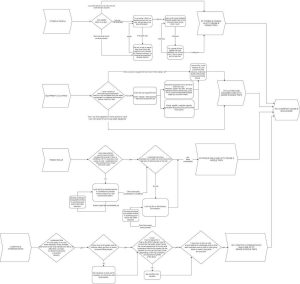
Try this flow chart if you are progressing from Grade A to Grade B. [ click image to see a pdf ]
You must be logged in to post a comment.