

Welcome to the latest edition of the Craic’n, the official newsletter of Drumchapel and Clydebank Kayak Club.
For some newer members this may be your first newsletter, I hope you enjoy reading it. Please feel free to pass on any comments or contributions to me or any committee member.
For long standing members you many be wondering when this was going to land in your inbox. Apologies for the missed deadlines and delays – I hope you think the wait is worth it.
A lot has been going on since the January newsletter, much of it behind the scenes, including managing changes introduced by Paddle Scotland. Some of these changes have resulted in the Sea Kayak Leader and Paddlesport Leader training that many of us are involved with. These will help the club continue to offer safe paddling in a variety of settings and equip us with qualified trip leaders well into the future.
Good to say there has also been a lot of recreational paddling going on too. Day trips on Loch Lomond and the Clyde, both by day and by night, weekend trips to the Garvellachs*, another round Gigha, a litter-pick on the canal, and even a river trip or two**.
Tuesday evenings are now in full swing at Loch Lomond and Thursday evenings at Pinkston*** have also started up for the summer. See the club calendar for more information about these sessions and upcoming events – https://dckc.co.uk/calendar/club-calendar/
* For a brief of the history of the Garvellachs see “Green Isle of the Saint” in the March 2024 issue of the Craic’n – https://dckc.co.uk/craic/
Issue 19 September 2024 (a typo mis-names it July 2024) has a full index to all earlier editions.
Stop Press News
** River Trips The next published club river trip is on the 7th of June. The club has a range of river kayaks, paddles, helmets and other equipment. that you can use. You can find out more at https://dckc.co.uk/event/river-trip-grade-2-3-2/ or feel free to get in touch with graham.m.swanson@gmail.com If you are an existing river paddler then please remember to join the DCKC whatsapp group… we sometimes try to find suitable dates that people can make before publishing the trip on the calendar.
*** Pinkston Sessions The club runs Thursday evening club sessions at Pinkston Watersports in Glasgow in the moving water basin and the artificial white water course. If you are at the stage of thinking about progressing your paddling into moving water, then why not contact pinkston@dckc.co.uk to find out about how to come along. There is more info at https://dckc.co.uk/about-us/pinkston-club-night/ or speak to any of the others who come along.
In this edition:-
- 1. Storm Cags.
- 2. Members with Benefits – Paddle Scotland
- 3. Folding Kayaks – Why You Might Consider One.
- 4. Do you get your knickers in a twist?
- 5. Trip Report
1. Storm Cags
A storm cag is emergency kit to protect a kayaker from the cold and possible hypothermia. It is pulled over all existing clothing and buoyancy aid to provide an extra layer to prevent wind chill. It can be used as a spare layer for extra warmth and shelter during breaks, emergencies, or in inclement weather on or off the water.
I have recently been researching storm cags to add to my emergency kit and have been somewhat staggered by the price of them; £100 – £300 for a piece of clothing that is designed not fit you! Although it would also come in useful for other emergency situations, e.g winter mountaineering etc it still seems a lot of money.
I know some paddlers are using non-conventional cags, including an adapted cycle cape! So I started exploring options and came across the idea of using a Tyvek. This is the tough papery-type material that you see covering buildings under renovation/repair to keep the weather out. Those scary white protective suits are also made of it, as is a homemade paw-print for one of our tents! At just £17.60 for two Tyvek hooded jackets, including P&P, I thought I’d give the idea a try.
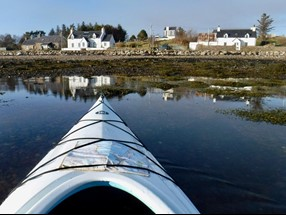
They arrived very quickly just a few days ago. Although not perfect, I am sure they will suit the purpose. The ideal storm cag has a wide skirt that can be used as a spray deck and pockets for snacks or keeping hands warm, this has neither. But it does have a large hood, big enough to take a helmet, and an elasticated waist to stop it flapping in the wind. The zip-up front may help to get it onto a very large paddler, but we had no problem getting it on over our drysuits and PFDs when fully zipped up. The fabric feels flexible, warm and soft and scrunches down to a tiny bundle, roughly the size of a 400g can of tomatoes, making storage easy and accessible.

We have yet to try them out on the water, they may not be the perfect storm cags, but I am optimistic that we have a useful piece of kit for a fraction of the typical price. Like my PLB (personal locator beacon), this is a piece of kit that will move between my mountain rucksack and my kayak, and I hope never to need to use either of them.
Have a look at them to form your own opinion next time you see us on/near the water. Any comments welcome.
Should you want to give these a try, this is where I bought ours from – https://www.ppe-online.co.uk/products/PPE/Disposables/Disposable-Coats-Jackets/40438654_Dupont-D13496041-Tyvek-Jacket-with-Hood-Pp33-Stitched-Seams-Zip-White-2XL Note the size – you’ll need the biggest one to serve as emergency kit for the largest member of a group.
2. Members With Benefits – Paddle Scotland
Paddle Scotland is the governing body for all paddlesport activities in Scotland. DCKC is an affiliated club, which provides benefits to the cub and its members and also imposes certain standards and obligations on the club. It also gives us access to the Just Go platform that we use for paying membership fees and booking events.
All DCKC members are automatically affiliated members of Paddle Scotland. This provides us all with insurance, Paddler Magazine and other benefits which can be seen here – https://www.paddlescotland.org.uk/resources/club-support-and-affiliation For most members this is all we need.
However, there are other memberships levels that you can choose to subscribe to. The one that interests me is Full Membership. This may seem pricey at £51 pa and, at first glance, the additional benefits may not seem worth the cost. However, this is one place where membership discounts really are true discounts. I have found many ‘discounts’ and offers to be a percentage off a full price that no one ever pays, making the net price the same for everyone; discount or not.
The Just Go discounts are available from a wide range of retailers & services, some of which you are bound to be using, often on a regular basis.

To obtain the discount, you either apply for a code or buy gift vouchers; the website makes the process clear. For example, most of the major supermarkets have a voucher scheme with 4-6% discount, so you pay £94-£96 for a £100 gift card that you can easily use at the checkout of the chosen store. With the current high price of groceries, you only have to do this 10 or 11 times, and you have made a saving.

These screenshots show only a small selection of options available. See here for more – https://www.paddlescotland.org.uk/membership/sca-membership-benefits, but you will need to sign up and log-on to see the full list. Happy shopping!
3. Folding Kayaks – Why You Might Consider One
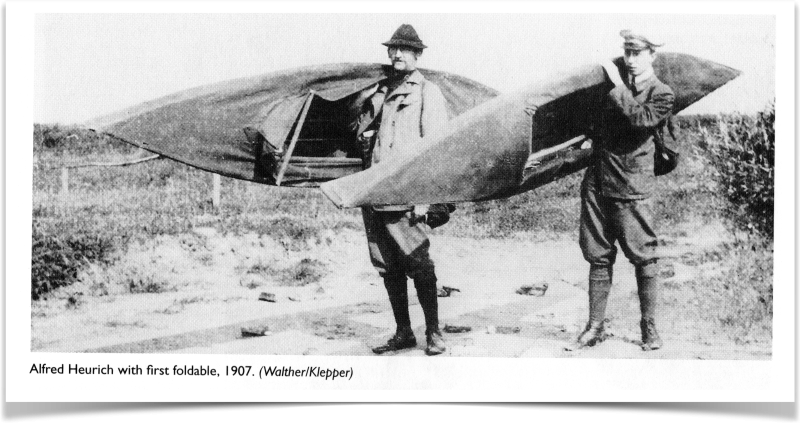
Folding kayaks are appealing not just for their go-anywhere and compact-storage attributes. They are exemplary sea-going vessels, since stability and seaworthiness are inherent in their design, which closely resemble the skin-and-frame construction of the Arctic peoples’ kayaks. Most foldables build on that heritage and today have demonstrated their capabilities in rugged use by noted explorers and the military.
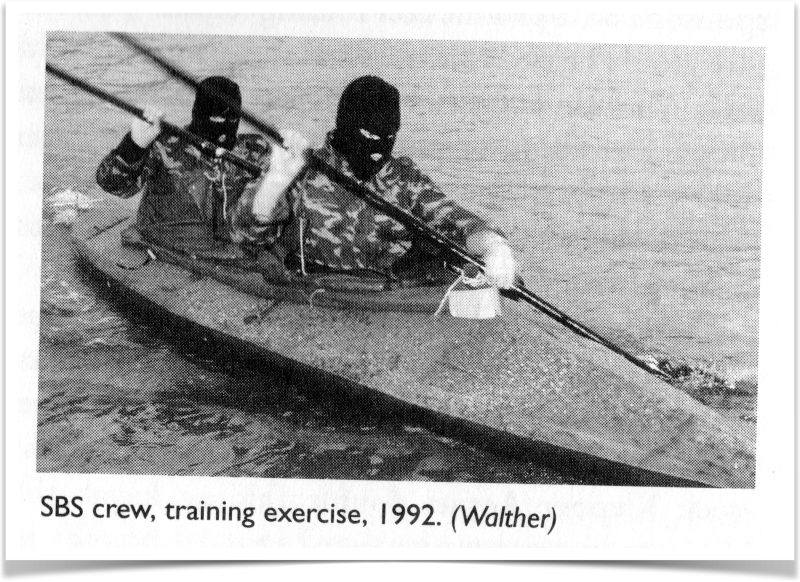
When comparing the common-place hardshell kayak, made of a fibre-composite or plastic, with the far less numerous folding kayak, you are likely to encounter some misconceptions about foldables. Folding boats are supposed to ‘lack performance’ and are considered vulnerable, constantly in need of maintenance, and are not even considered by some to be sea kayaks at all.
So, why might you consider a type of boat that has limited choices?
My old Shorter Oxford English Dictionary defines ‘kayak’ as “The canoe of the Greenlanders and other Eskimo [sic], made of a framework of light wood covered with sealskins sewn together”. Clearly, folding kayaks are truer descendants of the original kayak adhering more closely to the design, materials and principles developed thousands of years ago. The underlying structures common to both translate into some unique performance characteristics; characteristics that rigid kayaks cannot share.
Three principles of construction make the original kayaks such impressive seafaring vessels. Two of these are readily apparent, the third is not. Folding kayaks also share these design elements.-
- A pliable, fabric-type hull material
- Internal frames consisting of cross ribs and longitudinal pieces
- Inherent flex because its frame members and pliable skin have a combined ‘give’ to them.
Whilst the materials now used in folding kayaks differ from those of the original kayak, they perform identically. Now, we rely on modern materials such as Hypalon, modern urethane or vinyl-coated polyester for the skins and aluminium, wood and modern polymers for the frames.Because folding kayaks are meant for disassembly, their joints have some flex. This flex underlies their performance, which along with several other features, makes foldables inherently seaworthy and more stable than rigid kayaks.
First, they flex along their length, partly shaping the hull to the water’s curvature.
Second, they flex or twist laterally, enabling folding kayaks to absorb waves colliding from different directions in confused waters.
In addition, the softer sides dampen some of these forces allowing a foldable to blend with the sea’s action, not be tossed around by it.
Width also adds to the stability of folding kayaks, which tend to be a few centimetres wider than their rigid counterparts. The extra stability is not only because of these extra centimetres, but also because of the design feature that creates the extra width – air tubes along the sides.
Most folding kayaks today have these air tubes, or ‘sponsons’, that run the length of each side. They were introduced about 70 years ago to help the ease of assembly; the frame halves fit into the loose skin that tightens when the sponsons are inflated. The sponsons have the beneficial side effect of increasing stability, since, if a kayak is tipped slightly on its side, the sponsons will resist being submerged helping to keep the foldable upright.
The seaworthiness of folding kayaks is undoubted and has been proved on the high seas, including crossings of the Atlantic and in both polar regions.
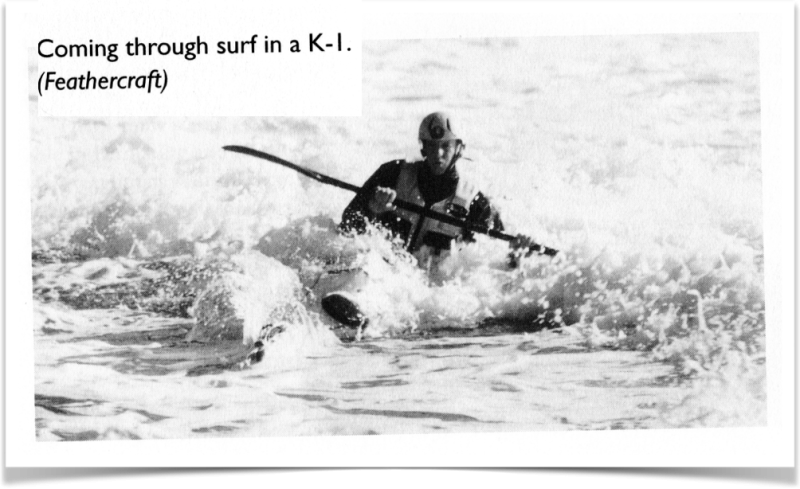
It is a given that a sea kayaker needs good paddling skills and the ability to ‘read’ sea conditions. Nevertheless, folding sea kayaks allow you to progress faster in your paddling skills, concentrating on developing an efficient forward paddling stroke, without needing a constant semi-brace to keep upright in heavy seas.
Contrary to the misconception, folding kayaks are not delicate. Their vulnerability is on par with a fibre-composite kayak, but they will outlive the rigid kayak. You treat a folding kayak hull with equal care as would an owner a composite hardshell. Having said this, it is surprising how much (ab)use the skins can take.
The skin-over-frame construction is strong and able to absorb plenty of punishment. The conditions that could break some frame pieces would also likely crack the hull of a rigid composite kayak or create serious stress fractures, compromising hull integrity. Such force could also dent or crease a plastic boat. The frames have proved their toughness by military special forces routinely dropping a fully loaded folding kayak between 3-5 metres from a helicopter hovering above the waves and swell.
Folding kayaks have impressively long lives. Wooden frames are still functional after 100 years. Aluminium frames have been used for around 50 years, and they are still holding up well. Hulls have long service lives. Hypalon lasts 30-40 years and some manufacturers now use other hull materials that also promise to have similarly long lives, but are lighter.
Should it be necessary, folding kayaks are easy to repair, whether at home or in the field. Duct tape adheres to folding kayak hulls in all temperatures and remains adhered for months. Individual frame pieces have a degree of redundancy, and can be temporarily repaired on a trip, and permanently repaired, or replaced, if necessary, once at home.
Folding kayaks are much more versatile too. They can be transported ready-to-float or packed in their bags. One-way trips, whether planned or forced by bad weather, public transport and accessing distant or remote locations all become possible. The superb stability makes for good sailing set-ups and platforms for other water-based activities, such as fishing or swimming.
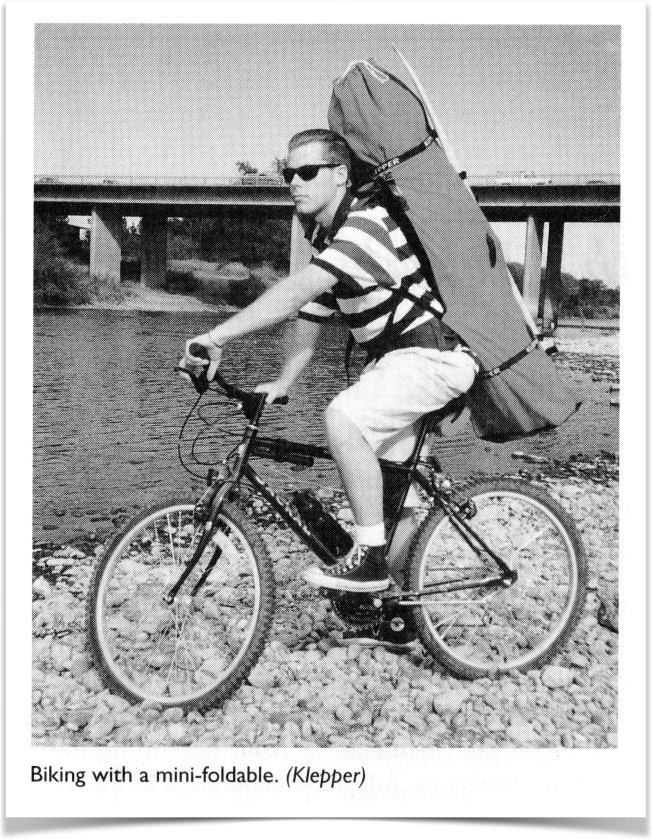
Perhaps the most outstanding attribute of a foldable kayak is safety. The risk of capsizing is far greater in a rigid boat, whilst, under severe conditions, even a paddler with moderate ability to brace can keep a foldable upright.
It is generally harder to roll in a folding kayak, but it is hard to capsize one in the first place too. Even under the worst circumstances, foldables also offer a more stable platform for re-entry than a rigid kayak. Safety benefits extend beyond ‘getting-back-in’. If an injury or fatigue incapacitates you, a folding kayak will float along nicely, without needing the helping hand of an assissted tow. Also, a partially filled hardshell is more difficult to paddle because of the instability caused by the swishing water, whereas the sponsons keep a folding kayak stable.
Finally, on the question of ‘performance’, it is true that the wider beam of a foldable is likely to have an impact depending on what ‘performance’ is being considered. It is generally harder to roll a foldable, as mentioned earlier, and a wider beam typically means forward speeds will be lower than a speed-oriented boat in calm sea conditions. However, the ‘effective’ beam, i.e. where it matters, at the waterline below the sponsons, isn’t as much as it appears. The flexible skin also has benefits of reduced drag, so foldables aren’t so disadvantaged in practice. In rougher conditions, however, the more stable platform plays to the advantages of a folding kayak, and the paddler can put more effort into forward paddling and less into strokes to maintain stability.
All in all, folding kayaks have excellent seaworthiness and reliability and good performance in common sea conditions around the Scottish coasts.
Amanda and I each own Feathercraft folding sea kayaks, which benefit from all of the features I’ve described here. In a future edition of Craic’n, I plan to write a personal review of our experiences of two Feathercraft models, the expedition-oriented K1 model, and the Kahuna, which is a lighter weight, slightly shorter but more stable craft.
Peter
May 2025
Notes:
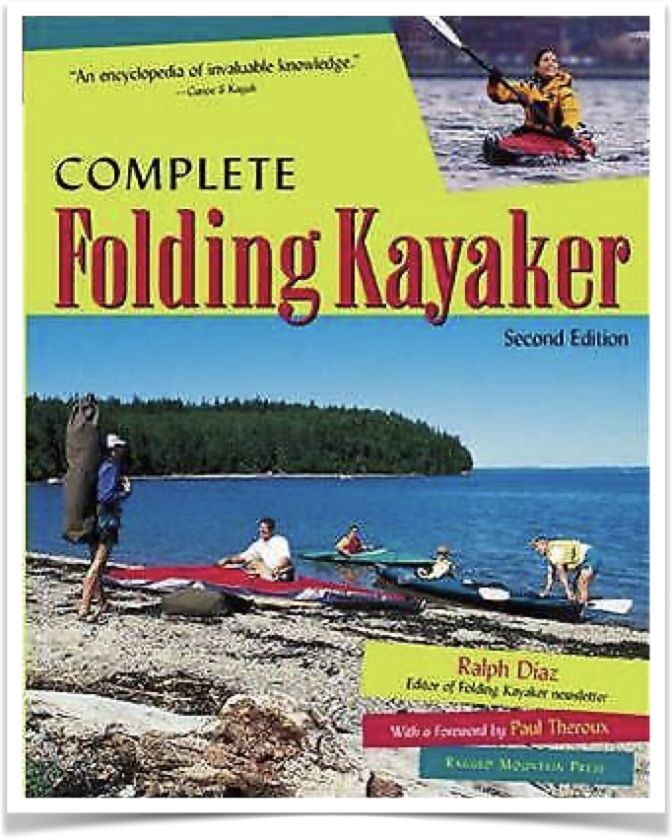
1: The above draws on a chapter in ‘Complete Folding Kayaker’ by Ralph Diaz together with some thoughts of my own. (The pictures are from the first edition publsihed in 1994)
2: Some recent brands of folding kayak do not share all the design aspects described here.
4. Do you get your knickers in a twist?

Sorry guys – this probably doesn’t relate to you, but may explain why you may find some unusual items in the washing pile!
This is a minority issue as only just under 40% of the club membership are women, not all of whom use a drysuit, but most of us who paddle over the winter months certainly do. So how many of you have the same problem that I have – adjusting your clothing after a comfort break?
I know some people try to avoid drinking too much fluid to limit pee stops, but this is not recommended practice as efficient physical exercise requires a fully hydrated body, before during and after activity. So it is important to drink plenty of fluid while paddling, including a hot drink during any rest stops. All this creates the need to pee at least once during the day.
In the winter I usually wear two layers on my legs, these alone are hard enough to pull up within the confines of the comfort-zip opening. Tucking them comfortably into upper garments for additional warmth is almost impossible with cold, damp hands. But before that there is the problem of the knickers! These invariably get twisted in the leggings or lost, escaping from being pulled up altogether – not at all nice.
So I after experimenting with my underwear collection, with little improvement in my afternoon paddling comfort, I have bought especially large ‘granny knickers’ (that I do not put out on the line to dry with the other washing) with good results, so far. The larger amount of fabric means they are less likely to get twisted or lost and make it easier to get hold of, pull up and tuck in, even with damp cold hands. All-in-all, for paddling they are more comfortable than my usual choices, and I think it worth a try at just £5-£8 for a pack of 3-5 pairs
However, I did a little bit of research, chatting with just one other female dry-suit user, and she disagreed, saying smaller knickers are the way to go. I’m not convinced she is correct, but either way it may be worth ditching the posh panties for paddling and choose a different style for comfort over from.

5. Trip Reports
RTrip roerts are posted in the Trip Seports section of the webpage with pictures in the SmugMug gallery.
Trip Reports are in the black strip at the very bottom of the home page. Picturers are in the About Us tab at the top of the Home page, click on ‘Gallery’.
Here is tatster of what has been posted recently:
Second Saturday Paddle 10 May 2025 – by Paul Meiklejohn.
“Originally planned as a trip from Helensburgh to Kilcreggan, the team of leaders made the call on the Friday evening to relocate to Loch Lomond due to the forecast Force 4 to 6 winds that would be beyond conditions suited to our group. … … … …”
“On the way to the island we had a short unscheduled stop on the beach around Arden … … …”
“The very minute we got back in the kayaks, the wind picked up … … …”
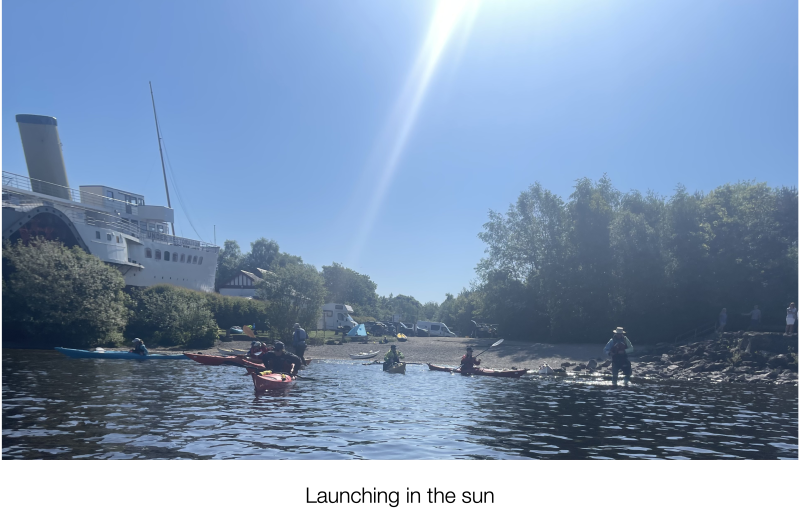
Gigha 2025 by Rob Plant
Celia planned another kayaking trip around Gigha for the long May bank holiday weekend. (Perhaps this is to become an annual fixture in the cub calendar? Ed)
“… … … … the crossing was too exposed for a direct paddle.”
“… … … …. the wind and swell were pushing us from behind, making for a brisk paddle.”
“… … … … all of his Lomo dry bags had failed.

That evening, we took a short hike up to Brownie’s Chair and were lucky enough to spot a pair of sea eagles along the way. We also saw some goats on the island and enjoyed a beautiful sunset over the Paps of Jura on our walk back to the tents.

“… … … …There was some fun rock hopping and interesting rock formations along the way”
“… … …The wind had calmed enough to make a direct crossing feasible without the ferry”
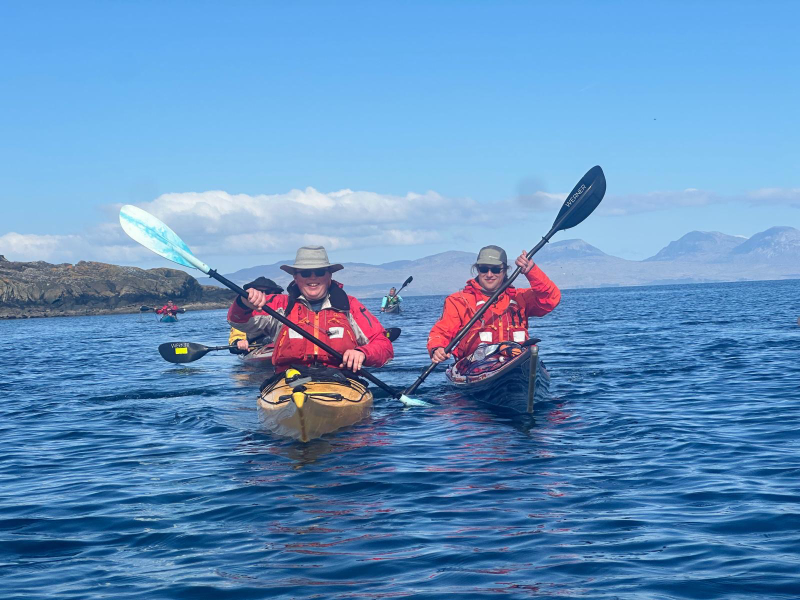
Top tips for a camping trip: –Double bag essential kit – clothes and sleeping bag; Keep some earplugs in the sleeping bag; Eye mask as it gets bright early; Pick easy things to cook; Practice pitching the tent.
Finally
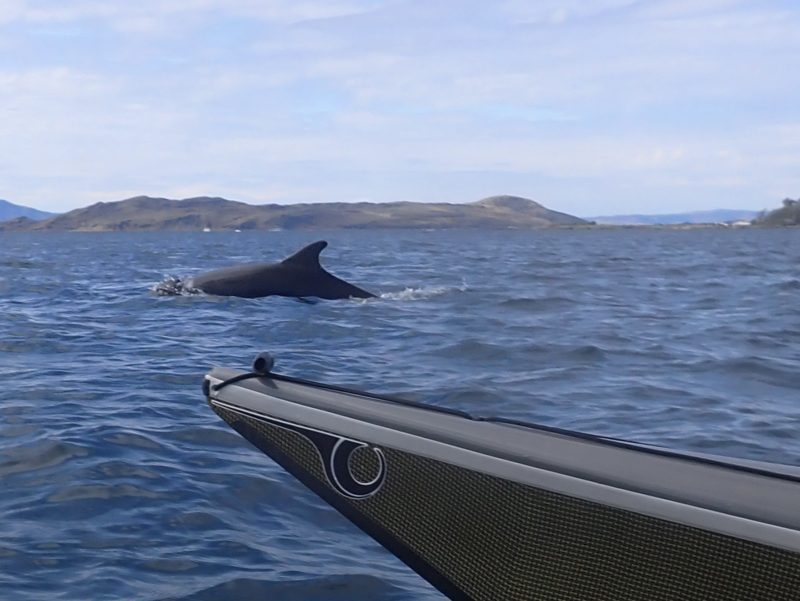
A picture of a bottle nose dolphin, seen near Lttle Cumbrae – just to ensure you finish reading this with a smile on your face.

You must be logged in to post a comment.