
Trip Report Gigha Circumnavigation – 1st May 2026
Matthew M.
N-going stream begins -04:30 Oban /S-going stream begins -0155 Oban /Sp rate 1.5kn. Clyde Cruising Club Sailing Directions Part 2.
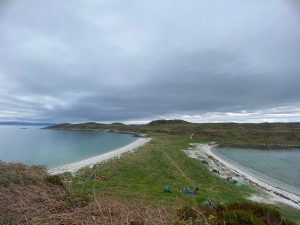
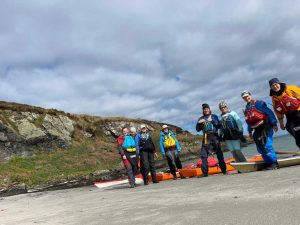
The trip leader was Celia and we arranged to meet at the Tayinloan ferry car park for midday. The boats and gear were carried across the car park and onto the beach where after a briefing the group set out to cross the sound at slack tide making for Ardminish Bay.
I love the feeling of settling into a loaded boat and starting an adventure. The crossing was fun, and we made good time across the water, arriving in the bay an hour later in bright sunshine with a following wind.
Some of the group set out to explore the village, shop and Achamore House gardens. Sir James Horlick (of the nighttime beverage) bought Gigha in 1944. The island was subsequently sold and bought with a combination of HIDB grant and National Lottery Funding and remains as community owned. (Hamish Haswell-Smith’s Guide to “The Scottish Islands) The gardens are beautiful and feature varied deciduous tress, rhododendron, azalea and other subtropical varieties. Having been on the island before I took the lazy choice and laid out in the sun.
We then set course for Cara island for our first night. The passage passes various rocks and small islands including Eileen Laith (grey island) Eileen a’ Chuil (island of the dead) and at Gigalum I kept my eye out for an otters or seals that might be working the shoreline. In fact, we spotted a dazzle-camouflaged (that didn’t much hide it) house on Gigalum owned by Scottish Home of the Year judge Anna Campbell Jones who had ‘reimagined’ a 1970’s “bothy” in a quite incongruous manner. The jury remained unconvinced as we paddled towards Cara via the Cara reefs, a series of awash rocks in the passage.
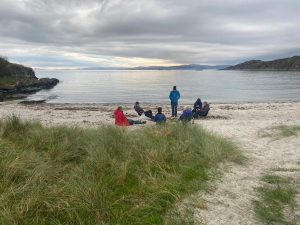 There was a quite strong breeze blowing as we arrived at Port an Stoir beach. We decided that his would be too windy for a camp and proceeded round the eastern side of Cara to Port na Cille (Monkshaven). Here we decided would be a more sheltered spot for the night, and we drew ashore and began pitching our tents and making ready for an evening meal and fire. We had brought some wood and a few pickings from along a sea-weedy shore line were enough for a modest blaze. I was glad I brought a jacket however, and we soon retired to our tents for the night with the breeze building.
During the night I got up and heard what I thought was a bittern. Or was it the ghost we had been warned of? Cara has a long history of conflict and religion. In 1263 King Haakon’s fleet anchored in the sound and would have landed. Later in 1615 Sir James McDonald escaped from a Crown Prison and enlisted islanders to regain control of his lands from the Campbells. An uncorroborated story claims that the MacNeill and Campbells lords had dinner in the Cara House and then hung eight captured rebels in the garden before they were buried in the Chapel graveyard. According to the records of 1456 the chapel was the chapel of St.Finla a contemporary of St Columba. Cara has a long and at times difficult history. (Hamish Haswell-Smith’s Guide to “The Scottish Islands)
We woke to quite a firm southerly breeze and paddled out from Port na Cille into metre high waves. Since we were travelling south the wind was in our favour and the loaded boat felt wonderfully stable in the swell. We made good time to the south of the island passing by Brownies Chair where it is said the ghost of a murdered Mac Donald watches over the water. Passing under the Mull of Cara past the cave at Carriage Moor we found we were in shelter from the wind and the swell became longer. The paddle up the west side of Cara gives us good views of the islands rocky coastline with various reefs to navigate. We paddled up to the outlying rocks at Sgeir a’ Bhuntata (sgeir + reef) and then back to Gigha using the twin electricity turbines as a bearing for the route.
The west side of Gigha is rocky with occasional sandy beaches. We eventually stopped at Cuddy Port for some lunch. While the wind by now was much reduced the temperature was still quite cold. I was glad of a break before embarking on the second leg of the day a paddle north to the Twin beaches of Bagh Rubha Ruaidh (Red bay which was indeed red from the seaweed present).
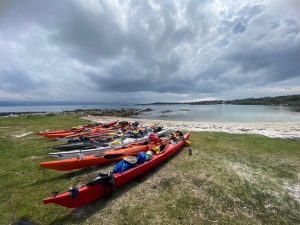
The shore line remains uninhabited and rocky along the edge of Gigha with a quite wide crossing at West Tarbert Bay. I was glad the wind wasn’t too strong because by the time we arrived I was ready to stop. The sun came out, and it felt great to be at our next camp.
The Twin Beaches are beautiful, and we camped alongside a sandy bank with Sand Martins busy with their first broods and wild flowers on the machair. Once again wood for a fire was in short supply, but we managed to have a good warm up and evening meals were cooked. Some round the fire drinks and tales of trips and club members past and present were shared.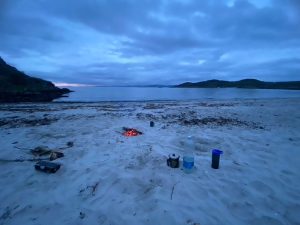
Our last day was bright sun and little wind. The tide was flowing south with us as we rounded Port Mor and began travelling back towards Ardminish. East Tarbert Bay is quite a wide bay with a large fish farm mid-way. The wind had by now swung round to be N-westerly so was on our side. We enjoyed fabulous views of Islay and Jura and up to the hills around Kilmory and Kilberry. Once we arrived at Drumyeon Bay we took a bearing on the caravan park at Point Sands and began the return crossing.
This was a lovely crossing. The sun was shining, the wind and waves following and Ceila had us paddle in a line to make us most visible to the ferry or other traffic which made it all the more sociable. We arrived back at Tayinloan on something of a high in bright sunshine. Many thanks too Ceila had directed a perfect trip in almost perfect conditions, and the rest of the crew. My only complaint, it was all over too soon !
You must be logged in to post a comment.